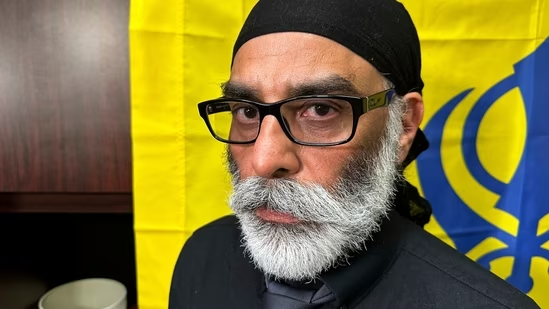
Nikhil Gupta, arrested in failed plot to kill Gurpatwant Pannun, moves Supreme Court

Nikhil Gupta, arrested in failed plot to kill Gurpatwant Pannun, moves Supreme Court

 Nikhil Gupta, the Indian national accused of involvement in a foiled plot to assassinate Sikh separatist Gurpatwant Singh Pannun, has taken his case to the Supreme Court, as reported recently. The family of Gupta has filed a habeas corpus petition, urging the Indian government's intervention to secure his release from custody in the Czech Republic, according to Live Law.

Last month, US federal prosecutors charged Nikhil Gupta with conspiring to kill Pannun, an American and Canadian citizen known for his Sikh extremist views. The Department of Justice claimed that Gupta, along with an unnamed Indian official, orchestrated the plot and even hired someone in the US to carry out the assassination.

The Czech Ministry of Justice confirmed Gupta's arrest and provisional custody, disclosing that the action was taken at the request of the United States. Vladimir Repka, a spokesperson for the ministry, mentioned that the US submitted an extradition request, citing charges that include conspiracy to commit murder for hire, according to US authorities.

India Today reported that the Ministry of Justice in the Czech Republic has officially acknowledged the arrest and custody of Nikhil Gupta, indicating a significant development in the case. The US government's direct involvement in the matter has raised concerns in India, prompting the Indian government to describe it as a "matter of concern."

In response to the allegations, India has initiated an inquiry panel to investigate the links between the accused Indian official and Nikhil Gupta. The US Principal Deputy NSA, Jonathan Finer, conveyed the importance of accountability during his recent visit to India. The White House issued a statement acknowledging India's establishment of a committee to probe the "lethal plotting" and emphasized the need to hold those responsible accountable.

The specific Indian officials with whom Finer discussed the issue were not mentioned in the official readout. The situation continues to unfold as the legal proceedings progress, shedding light on the complex international dimensions of the case.

Comments

Popular posts from this blog

Syria Condemns Israeli Incursion into Beit Jinn, Holds Israel Responsible for Escalation

 Syria strongly condemned an Israeli military incursion into the town of Beit Jinn in rural Damascus, denouncing the assault on civilians and their property, which resulted in casualties and widespread panic. In an official statement, the Syrian Ministry of Foreign Affairs described the incursion as a war crime, stating it followed Israel’s failed attempt to target the town. The ministry held Israeli authorities fully responsible for the aggression and its consequences. Syria called on the UN Security Council, the United Nations, and the Arab League to take urgent action to halt repeated violations. It reaffirmed its commitment to defending its sovereignty and people through all means permitted under international law.

Israel issues latest forced evacuation order in areas in Khan Younis

  The Israeli army’s Arabic-language spokesperson, Avichay Adraee, has issued the latest forced evacuation order for civilians living in nine areas in Khan Younis, southern Gaza. Adraee said that the army was expanding its operation and “intensifying sudden and concentrated firepower”. The spokesperson called on residents to evacuate westward. So-called Israeli safe zones, including Al-Mawasi in Khan Younis, are routinely attacked despite the army forcing Palestinians to move to those areas.

Bombay High Court Restricts Bursting of Firecrackers in Mumbai During Diwali to These Timings

  The festival of Diwali, often referred to as the "Festival of Lights," is celebrated with great enthusiasm and fervor across India. While the tradition of lighting lamps and bursting firecrackers has been an integral part of the festivities, concerns over air pollution and its adverse effects on public health have prompted authorities to regulate the use of fireworks. The Bombay High Court , in a recent decision, has imposed restrictions on the bursting of firecrackers in Mumbai during Diwali, specifying designated timings to minimize the environmental impact. In an effort to strike a balance between celebrating the festival and safeguarding the environment, the Bombay High Court issued a directive that restricts the use of firecrackers to specific time slots. The court's decision is a response to the rising concerns about air quality and noise pollution during Diwali, which often reaches hazardous levels in several Indian cities. These timings aim to strike a balance b...